
2026-08-31
Private Label Wine With No Minimum Order
Learn how no-minimum private label wine works, what you can customize, and when a small first order makes business sense.
Private Label Wine With No Minimum Order
Most founders hear the same thing when they start calling wineries: commit to a pallet, a production run, or enough cases to make the line setup worthwhile. That is reasonable for a winery. It is also a rough starting point for a new brand that still needs to prove demand.
Private label wine no minimum programs solve a specific problem. They let you begin with finished, compliant wine from an existing library and order only what you can realistically sell. You trade some production control for speed, lower inventory exposure, and a cleaner way to test your idea.
But "no minimum" does not mean unlimited customization at zero setup cost. The useful question is not whether a supplier advertises no minimum. It is what remains flexible, what is already fixed, and how the economics change as your order grows.
What No Minimum Actually Means
In a true private label wine no minimum program, the winery does not require a minimum bottle or case quantity for the wine itself. You select from wine that has already been produced, stabilized, and made ready for a private label.
That structure avoids firing up a bottling line for a tiny custom production run. Your order may come from finished inventory or a library of available lots. The supplier can apply your approved label to the number of bottles you need, subject to packaging availability and compliance requirements.
There can still be practical minimums elsewhere. A label printer might price in sheets or rolls. A custom carton vendor may require a certain quantity. Freight carriers have their own pricing thresholds. Ask the supplier to separate the wine minimum from the minimums for labels, capsules, cartons, and shipping.
White Label Wines maintains a no-minimum library at its Temecula facility for this model. Buyers can start with an available wine instead of commissioning a new vintage. The program is useful for market tests, small hospitality programs, gifts, and first releases where tying up cash in inventory would be premature.
The Difference Between Library Wine and Custom Production
There are two very different ways to put your name on wine.
The first is library-based private label. The wine profile, vintage, and appellation are already established. You choose an available option, develop compliant packaging, and place an order. This is the usual foundation for private label wine no minimum offers.
The second is custom production. You may select a specific bulk lot, adjust a blend, choose exact packaging components, or produce through a custom crush arrangement. That flexibility requires planning, cellar work, dry goods, and bottling time. Meaningful minimums become necessary because the production costs exist whether the run fills 50 bottles or 5,000.
Neither approach is inherently better. A library program helps you validate the brand. Custom production helps you create a more proprietary product once volume and customer feedback justify it. Our guide to private label and white label wine explains the broader production distinction.
What You Can Customize on a Small Order
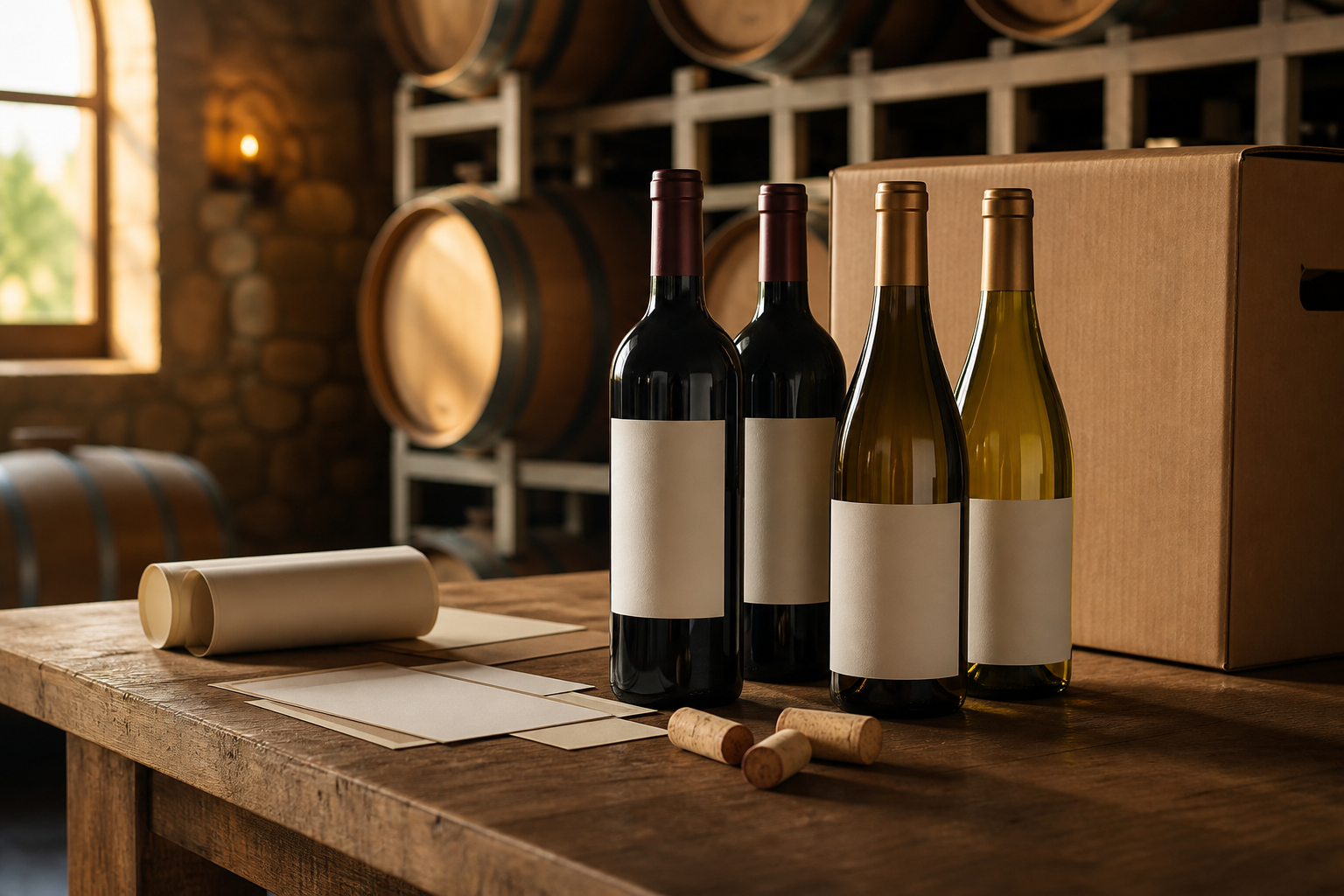
The label is where a small launch can still feel fully yours. Brand name, visual identity, front-label hierarchy, and back-label voice can all be developed around the buyer you want to reach. Strong custom wine labels make an existing wine library commercially distinct without pretending the liquid was built from scratch.
You may also have choices among bottle formats, wine styles, closure colors, or capsule colors, depending on what the supplier keeps in stock. Availability matters. A no-minimum program works because it uses components already on hand, so an unusual bottle mold or a custom-printed capsule usually moves the project into minimum-order territory.
Be precise about the product claim. Your label must accurately reflect the wine in the bottle, including appellation, alcohol content, class or type, and other required statements. A clever design cannot override federal and state rules.
If a supplier promises complete customization on one bottle, ask how. You want to know whether the result is a standard finished wine with a custom label, a digitally printed sample, or a genuinely custom-produced product. Those are different deliverables.
Compliance Still Applies at Any Quantity
One bottle and ten thousand bottles live under the same core alcohol-labeling framework. Small volume is not an exemption from TTB requirements.
The brand owner and winery need to establish who handles label review, Certificate of Label Approval work when required, formula questions when applicable, and state registration. The operating model also affects who can sell the wine and where it can ship.
White Label Wines provides TTB compliance help because this is where first-time buyers often lose time. The cleanest process begins before design is final. Confirm the wine details and mandatory label elements, then build the creative system around them. Redesigning after submission costs more than making room for compliance from the start.
Treat approval time as part of your launch schedule. Private label wine no minimum can shorten production lead time, but it cannot make regulatory review disappear.
When a No-Minimum Launch Makes Sense
A small first order is valuable when it answers a business question.
For a restaurant, that question might be whether guests accept a house Cabernet at a target menu price. For a real estate firm, it may be whether personalized closing gifts generate referrals. For an ecommerce founder, it may be whether a landing page and email list can convert without purchasing a warehouse of stock.
This approach is especially useful in four situations:
- Demand testing. Put a real product in front of buyers before forecasting a full run.
- Sales samples. Give distributors, accounts, or investors a finished bottle instead of a rendering.
- Short-run programs. Support a private dinner, client gift, seasonal package, or limited membership release.
- Portfolio testing. Compare interest in a red, white, and rosé before committing deeply to one style.
For the wider launch sequence, review our private label wine service. The goal is to make the smallest order that produces reliable evidence, not simply the smallest order a vendor will accept.
The Economics: Small Orders Cost More Per Bottle
No minimum reduces total cash at risk. It does not guarantee the lowest unit cost.
Setup work must still happen. Files need review, labels need printing, bottles need handling, and the order needs packing. Those costs are spread across fewer units, so the per-bottle price normally improves as volume rises.
Build a simple landed-cost model before ordering. Include wine, label design, label printing, application, packaging, compliance support, freight, storage, payment fees, and breakage allowance. Then compare that total with the price your channel can support.
A 12-bottle test can be successful even with weak margins if its job is to win three wholesale accounts. A recurring consumer offer needs healthier unit economics. Define the job of the batch before judging its cost.
Also ask for price breaks. A transparent supplier should show how the economics change at one case, five cases, a pallet, and a custom run. That gives you a path from private label wine no minimum to a scale that supports stronger margins.
How to Evaluate a No-Minimum Supplier
Start with the available wine, not the marketing headline. Taste the current lots and request the relevant technical details. Wine libraries change, so confirm whether the same wine will be available when you reorder.
Then ask direct operational questions:
- Is there truly no minimum on finished bottles, or only on samples?
- Which wine styles, vintages, and appellations are available now?
- What label-printing or setup charges apply?
- Who reviews and submits compliant label materials?
- Which bottle, closure, capsule, and carton options are stocked?
- What is the normal turnaround after artwork approval?
- Can the supplier support larger runs or custom crush later?
- Who is responsible for freight, storage, and damaged shipments?
Sourcing depth matters if you expect to grow. Access to Napa, Sonoma, and Paso Robles wine can create a logical next step after a library test. A supplier with wholesale wine sourcing and custom crush capabilities can help you scale without rebuilding the entire relationship.
A Practical First-Order Plan
Choose one customer, one occasion, and one target price. Avoid launching a broad portfolio because the supplier makes it possible. Focus creates better feedback.
Next, taste a short list of available wines blind if you can. Pick for the customer and channel, not for the founder's personal cellar. Confirm the exact wine details before the label moves into final design.
Order enough to cover samples, photography, breakage, and the first selling window. Set a decision date. If the batch reaches a defined sales or reorder threshold, move to the next volume tier. If it misses, learn whether the issue was the wine, positioning, price, packaging, or channel.
That is the real advantage of private label wine no minimum. It turns an expensive guess into a controlled commercial test.
Frequently Asked Questions
Can I order just one bottle of private label wine?
Some no-minimum libraries allow a single finished bottle, but setup, label printing, and shipping can make a case more practical. Confirm that the offer applies to sellable labeled wine rather than samples only.
Is no-minimum wine made specifically for my brand?
Usually not. Most programs use an existing compliant wine and customize the label. A unique blend or dedicated production generally requires a larger commitment.
Can I use my own bottle and closure?
Possibly, but custom dry goods often carry supplier minimums and setup costs. Stock components preserve the speed and flexibility of the no-minimum model.
How long does a small private label order take?
Timing depends on wine availability, artwork readiness, regulatory review, label printing, and scheduling. Ask for a timeline that begins with approved artwork, not the first sales call.
Can a no-minimum brand scale into custom wine later?
Yes. That is one of the strongest reasons to choose a partner with sourcing, bottling, and custom crush capability. Your early sales data can guide a larger and more proprietary production plan.
Start With a Test You Can Learn From
Your first order should buy information as well as wine. Choose a clear audience, select an available lot, build a compliant label, and measure the response before committing more capital.
White Label Wines can help you evaluate a no-minimum library option in Temecula and map the next step if demand supports a larger run. Start a conversation about your wine brand.
CONTINUE READING